
Finding Her Sound: A Life in Blues, Soul, and Queer Storytelling
Photographer’s statement:
“I was immediately welcomed into Georgia’s studio in her home, where her two little dogs were there to greet me. More importantly, I was struck by the warmth and authenticity Georgia brought to our conversation. Her long history with music, her commitment to her craft, and the way she speaks about the people and experiences that have shaped her made me feel that her story could resonate with others in our community.
I think stories like Georgia’s are important because, for many of us in the LGBTIQ+ community, growing up without many people to look up to can make finding your own path a little harder. I think there’s something really valuable in being able to see people like Georgia doing what she loves, being unapologetically herself and creating a space where others can feel they belong too." Maya Sugiharto
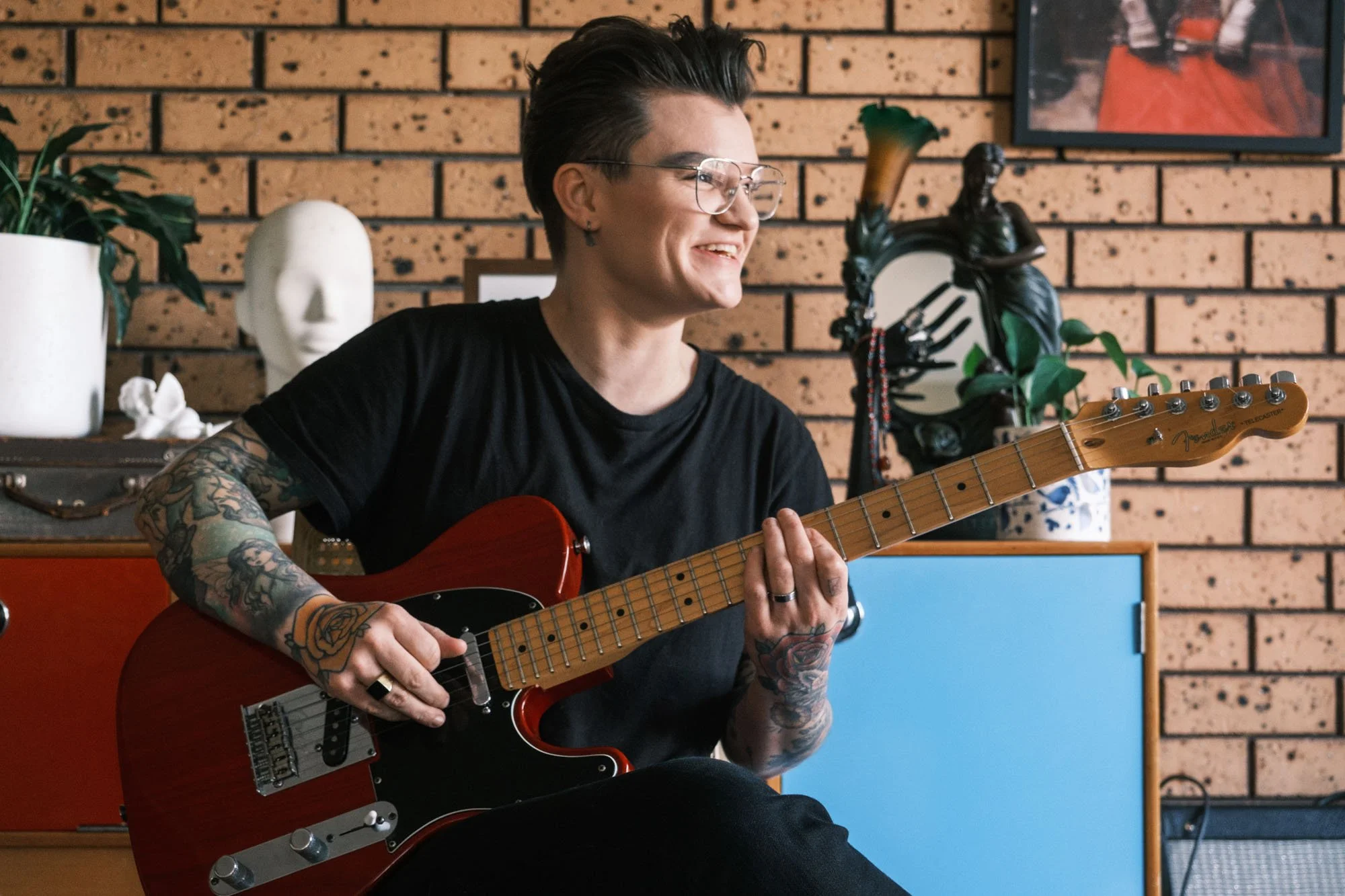
Photography: Maya Sugiharto | AGENT MORPHE
Tell me about your music.
I’d probably describe it as blues, soul, and a bit of rock. I try not to write with a particular genre in mind. There’s definitely some rock in there, and a bit of atmospheric, sound‑scapey stuff too. It’s quite soulful, but not really folk. I used to play more acoustic, but these days it’s a slightly grungier, more badass version of soul - which I love.
Being a solo artist makes it a little different. When you’ve only got one instrument, it can be tricky to fit neatly into a genre. So I’d say it’s a mix of rock, blues, and soul.
How long have you been doing music?
I got my first guitar when I was six, basically when I started primary school- and I never really stopped. I had an awesome guitar teacher, and then I joined a group called The Sweethearts in Geelong. It was about 30 girls playing soul music, and that’s where a lot of my inspiration came from. We toured Europe and played places like Cherry Bar on the first Thursday of every month. It was an amazing experience.
Being part of that group really reinforced that music was what I wanted to do. By the time I was eight, I was already really into it. So yeah, I’ve been doing music for about 20 years now, through lots of different bands and groups. I’ve played in a six‑piece band, but I always come back to my solo stuff; that’s where my craft sits.
Do you write and produce your own songs?
Yeah, I write all my own songs. And if I’m doing covers, I try to reinvent them a little. I want to honour the original while interpreting it through my own sound.
When I’m performing, most of what I play is my own music. I studied sound production for a while because I wanted to understand enough to make a decent demo. Producing uses a different side of the brain; you’re sitting at a computer thinking about technical elements, whereas when I’m playing, I’m creating sounds through pedal effects.
I’m writing all the time. That part never really stops.


What’s your favourite part of the whole production process?
Definitely the performance side. I love recording; it’s a big, intense process, but performing is where I feel most alive. I love the challenge of capturing what you’ve written and bringing the live energy into the recording.
Studio work is everything in one, and I enjoy it, but it’s expensive and can take days. Performing is immediate. You can’t overthink it. You can absolutely stuff it up - I often do - but that’s part of it.
There’s this whole cycle of writing, rehearsing, refining, and then presenting it. Performing is my favourite part.
Looking back from when you started at six, how did you end up here and find your sound?
(A picture fell off the wall during this question - maybe my Pop saying hello. He always loved that I was into music.)
I think it’s been a combination of experiences, practice, and continuing to learn. The music industry is interesting, and sometimes you forget why you started - because it was fun, because you wanted to learn, because you enjoyed watching people, talking to people, listening and writing.
I’ve met amazing people through music, especially women and queer women who are older, more established, and have been in the industry for a long time. Those relationships have shaped me.
I’ve worked very hard and probably spent more money on music than I’ll ever make back, but you don’t think about that when you’re in it. You just keep going because you love it. I don’t think I’ll ever stop playing, which is why I’m not in a rush to put out as much as possible. I’ve got time.
The Sweethearts was a huge part of that. It was intense, but we were lucky: mentors, workshops, touring Europe, playing Porretta Soul Festival, even a documentary. Those years were special. That was also around the time I came out, so music became an outlet without me even realising it.
I don’t want everything to be about being queer; that’s not what my career is about, but it’s part of who I am, and it comes through in my songs. Sometimes it’s quite tongue‑in‑cheek.
You mentioned touring Europe with The Sweethearts. How old were you?
I was about 14. That was a real catalyst for me. We practised constantly, and I loved performing. It was such a special experience.

I was about 14. That was a real catalyst for me. We practised constantly, and I loved performing. It was such a special experience.
What did you do in the group?
I played guitar, and that’s where I started singing a little. There were about 18 people on stage: brass section, backing vocalists, rhythm section, everything. We rotated through songs, so I think I played three or four when we were in Europe.
One of the singers and I also wrote a bunch of songs together. We had a band outside of The Sweethearts because we loved the same music. We became close, started a couple of bands, and eventually had some of our songs signed to The Sweethearts. It felt like a nice way to honour the group.
How did those experiences influence where you are now?
A huge part of it was the people who believed in me and didn’t care who I was. That’s massive when you’re young. Back then, there wasn’t the same level of acceptance or resources. Things have changed, but there’s still a way to go.
Having people around you who make you feel like you belong can have a huge impact. Those people and experiences are a big part of why I’m still doing this.


What would you like people to feel when they hear your music for the first time?
I’d like people to feel connected. I play with a lot of dynamics, volume, storytelling, and I want people to feel part of the story but also interpret it their own way.
I don’t like explaining exactly what my songs mean before I play them. Once you tell someone what a song means, you take away their chance to find their own meaning. If someone hears a lyric and thinks it’s funny or silly or moving, that’s great.
I try to make the music feel big and carry people along with it. I want people to feel engaged and connected in whatever way works for them. And I like to shock people a little; that element of surprise is important.
Where can people find you and your music?
I’m on Instagram and Facebook, and I post there a lot. I like social media as a kind of diary, a way to document what I’m doing and involve people in the process.
I’ve got a couple of songs on Spotify, and my Lounge Room Session videos are on YouTube. YouTube is probably where most of my music is, which sounds old‑school, but it works. Instagram has all the links, so that’s the easiest place to start.
