A Living Archive: Joan Nestle, DAAFT, and the Queer Histories That Shape Us
Listen to the interview with Joan Nestle and Bridget Harilaou on the LOTL Lounge S1E3
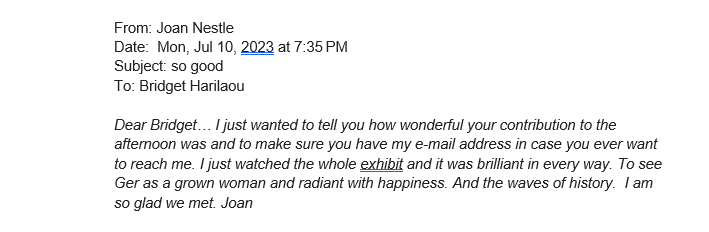
The NGV was brightly lit with photos and excerpts from an exhibition curated by the Queer Indonesia Archive (QIA).
Letters From Ger swept the whole room back to 1964, thanks to QIA’s painstaking work in collecting, preserving, and celebrating the lives of queer Indonesians.
Letters exchanged between Ger, an Indonesian lesbian woman, and Barbara, editor of the lesbian magazine The Ladder, created a window into the richness of queer life during a time when so much of queer identity in Indonesia was suppressed.
Ger was a pioneer - the first lesbian to be openly photographed and featured on the cover of The Ladder, or any magazine. As a queer Indonesian, I was honoured to read one of Ger’s letters at the exhibition launch. It was there, celebrating Ger’s life, that I first met Joan, who spoke to the audience about her experience as an archivist of queer histories.
I was captivated by Joan’s story as an elder within the queer community and how openly and warmly she shared her experience coming out as a lesbian in the Bronx in the 1950s. She felt an affinity with Ger, having grown up in a similar era, and she praised the importance of archival work and the respect she had for the Queer Indonesia Archive.
I was overcome with curiosity and wonder at the living history unfolding before me. Everything I knew about queer history had been read in books, watched in documentaries, or studied from afar. The 1950s and 60s, the Stonewall riots, even the stories of the 78ers and the first Mardi Gras - these were not stories I had ever heard in person. I had never met any queer person over 80 who had been out since they were young. Listening to Joan for the first time, I realised how hungry I was for tangible life stories from someone I could sit with, listen to, have tea with, and hold.
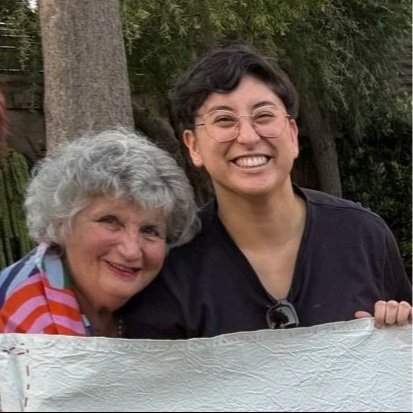
After the launch, I sheepishly approached Joan to express how wonderful it was to hear her speak. She insisted on grabbing my email. And so, a beautiful friendship began.
Joan Nestle and Bridget Harilaou, Photo supplied
Joan is, in fact, quite famous - something I didn’t realise until much later. She is an award‑winning writer, a teacher, and the founder of the Lesbian Herstory Archives in New York.
Every few months over coffee, I would savour another story, another gem. The more time you spend with Joan, the more you realise every conversation leaves you richer. She articulates ideas and histories with the stunning precision of a seasoned writer who has lived a dozen lives.
With each visit, I became more enamoured with her cottage in inner‑city Melbourne and the love she shares with her partner of almost 30 years, Di. How they declared their love on the banks of the Hudson River; her journey to Australia on a partner visa before marriage equality; the origins of the enormous trees in their backyard and how baffling it was when Di first planted them as saplings.
“I had no idea you could build a life with someone where you get to watch trees grow.”
Throughout our friendship, Joan has encouraged me to keep writing, supporting me in the natural way of a teacher honed through her many years at Queens College in New York. She gifted me a copy of her latest book, A Sturdy Yes of a People, with a handwritten note on the first page. She suggested I write for the Melbourne edition of Sinister Wisdom, and even sent a packet of my writing to the Lesbian Herstory Archives in New York.
Perhaps most uniquely, Joan connected me to an intergenerational activist group she helped found: Dykes and Accomplices Against Fascism and Transphobia (DAAFT).
The political rift between older and younger queer generations can be palpable - whether it’s views on police participation in Midsumma, differences in class politics, the generational wealth divide, or trans rights. It felt wondrous that Joan could tell stories of the trans people she has always shared community with, from 1958 in Bronx bars to DAAFT meetings in 2026.
Joan was inspired to challenge the transphobia being championed by a small but vocal minority of lesbians. To see any person as less than human is fascism, and this is the origin of DAAFT. DAAFT exists to affirm humanity and affirm life.
DAAFT’s first meetings were held at Joan’s home, which has become a regular gathering place for us, hosting banner‑painting days, book clubs, and many an afternoon tea.
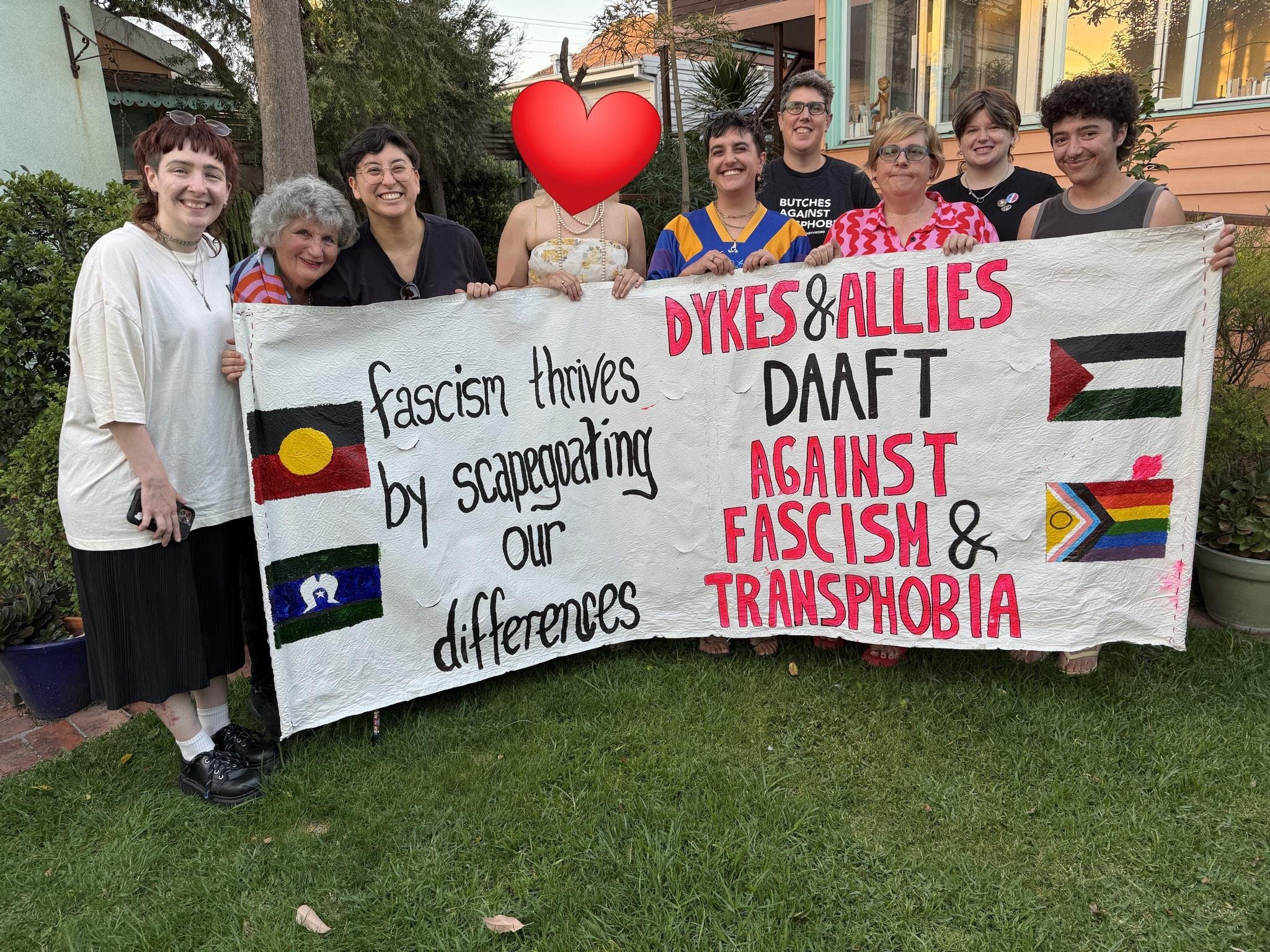
Bridget Harilaou, Joan Nestle and DAAFT members, Photo supplied
Opening her home is second nature to Joan. For many years, her rent‑controlled apartment in New York housed the Lesbian Herstory Archives. The large, beautiful apartment became a home to her lover at the time, her mother Regina Nestle in her old age, and the books, artefacts, materials, and art of the queer community in New York.
There were always people coming and going, sometimes lingering outside the building, wondering if they were in the right place, waiting to be invited in. While the Archives now have a dedicated three‑storey brownstone in Park Slope, Brooklyn, they were born in Joan’s home as a thriving community space.
Joan brings this same energy to her Melbourne home with ease: a ramp‑accessible entrance and guest suite, a beautiful garden for hosting, space to store banners and signs, and an abundance of food and love overflowing from the rafters. There is even a view of the city - a deck built by Di to match the Manhattan skyline Joan left behind almost 30 years ago.
Some people drop into DAAFT meetings once; others become regulars. I was delighted when a one‑off attendee mentioned, “You know, I attended a trans and gender‑diverse inclusive poetry party here about 15 years ago.”
A juicy tidbit about the magic and history living within the cottage walls.
DAAFT has members in their early 20s who are deeply connected to activist organising in Melbourne, bringing new events, discourse, and ideas. We learn from younger members just as much as we listen to the stories and lived experience of older members.
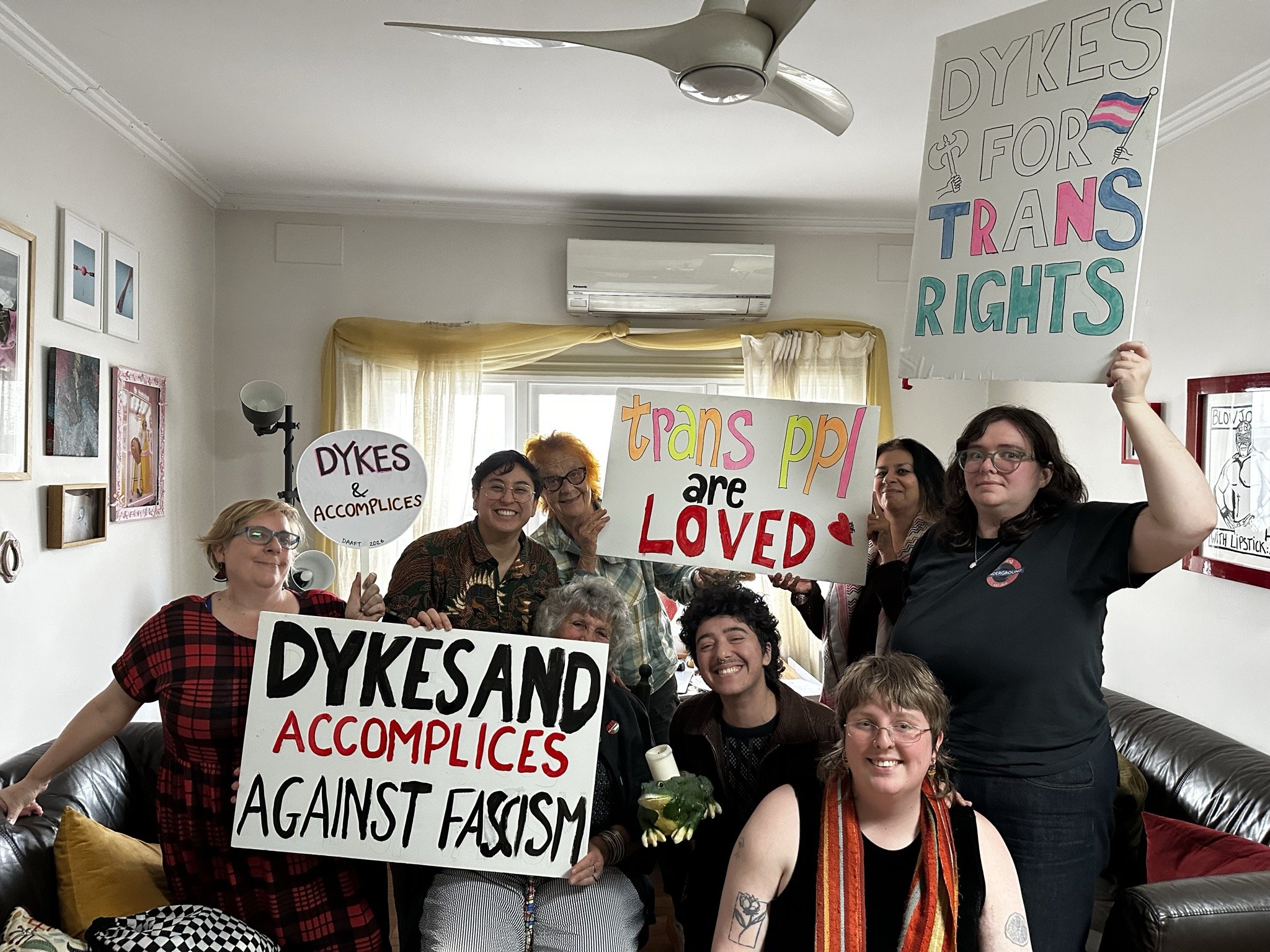
The group’s name originally began as Dykes and Allies Against Fascism and Transphobia,
to include the many gender‑diverse members who do not necessarily identify as lesbians or dykes. The term "Accomplices" was introduced by younger activists, inspired by the zine Accomplices Not Allies: An Indigenous Perspective, which affirms a commitment to solidarity across race, gender, sexuality, and generations.
DAAFT members have embraced this more active, staunch term as we combine generational wisdom with contemporary liberatory frameworks, photography, graphic design, writing, and art curation. The DAAFT community includes people from Italy, Scotland, and across Australia. We’ve recently developed a calling card to hand out at rallies and an Instagram to connect with the queer community.
Joan always reminds us that DAAFT is whatever we make of it — something we build together. We are not just activists but people with a centring love for humanity, which Joan shows us by example. Her love of people is the centre of her politics; it is abundant and knows no borders of country, generation, race, or gender.
Joan is an integral member of our queer community. She is not only an icon - she is a living, breathing part of our community, and we are so lucky to experience kinship with her.