Lesbian Involvement in Australia’s Early Gay Activism
Listen to the interview on the LOTL Lounge S1E3:
How lesbian activists shaped the foundations of Australia’s LGBTQ+ rights movement
The Daughters of Bilitis were the first lesbian political organisation formed in Australia. The group emerged in Melbourne in 1969 after two lesbians, Marion Norman and Claudia Pearce, contacted the American Daughters of Bilitis seeking information about organising lesbian groups locally. Both wanted to create a group that provided a social place for lesbians to connect, while also being political - working to promote lesbian information, visibility, and causes.
Based on the purposes of the US branches, the Australian DOB established itself with several goals. First, to educate lesbians about their identities on both personal and social levels. Second, to participate in “responsible” research about homosexuality. Third, to promote homosexual law reform, particularly the decriminalisation of male homosexuality. Overall, they aimed to educate the public about lesbians, hoping to break down taboos and prejudices through public meetings and sharing literature. They believed that familiarity with the word “lesbian” and its definition could correct many misconceptions in society.
“Lesbians were involved in gay activism from the very beginning, and their work helped shape the movement’s earliest public demonstrations.”
The DOB was featured on television in 1970 on an episode of The Bailey File, Channel Nine’s Melbourne-based current affairs program. Francesca Curtis came out publicly, spoke about the aims of the organisation, and called for lesbians to join. Later, four members were featured on the ABC’s This Day Tonight. These TV appearances included some of the first lesbians ever to come out publicly to the media in Australia. Members also performed outreach by speaking at community groups and women’s liberation meetings.
In 1970, the group renamed itself the Australasian Lesbian Movement to distinguish itself from the American organisation. The Australasian Lesbian Movement disbanded in late 1972. Although short-lived, it was undoubtedly one of the founding groups of Australian gay activism.
CAMP INC
CAMP INC was formed in 1970. The organisation’s name stood for Campaign Against Moral Persecution. They aimed to “bring about a situation where homosexuals can enjoy good jobs and security in those jobs, equal treatment under the law, and the right to serve our country without fear of exposure and contempt.” Founders Christabel Poll and John Ware were featured in The Australian in 1970, where Poll and Ware (and Ware’s partner Michael Cass) came out publicly, gaining national attention.
Multiple state branches of CAMP were founded in 1971, including Victoria (later renamed Society Five), Queensland, South Australia, Western Australia, and Tasmania. Campus-based CAMP groups were also established at universities around the country. CAMP NSW later introduced a phone counselling service staffed by members, called Phone A Friend.
CAMP members engaged in extensive public outreach and education. Members travelled to local businesses, universities, community groups, and hospitals to teach the public about homosexuality. They distributed written material to libraries and encouraged members to write to their local libraries requesting LGBTQ+ resources. Lesbians were involved in CAMP’s activism from the beginning, and at the very first public demonstration in support of gay rights in Australia in October 1971, they held signs with slogans such as “I am a lesbian and beautiful” and “Lesbians for Law Reform.”

Within CAMP NSW, several lesbian members formed the Camp Women’s Association (CWA) in 1972.
This group was created to specifically focus on lesbian issues, performing public political activism and producing a news sheet. Inspired by women’s liberation ideas, the group was concerned with the oppression of women both within CAMP and in broader society.
Mim Loftus 'I am a lesbian' at CAMP demo, by Phillip Potter - supplied by Australian Queer Archives (AQuA)
Several CAMP members publicly came out on the ABC TV show Chequerboard in an episode titled This Just Happens to Be a Part of Me. The episode is most remembered for showcasing the first male homosexual kiss on national TV between Peter de Waal and Peter Bonsall-Boone, but it also featured Sue Wills and Gaby Antolovich speaking about their identities and relationship. The couple discussed how their families reacted to them being together, and spoke about psychiatry and homosexuality.
Sue Wills was a key figure in activism against the psychiatric field. She interviewed psychiatrists accused of mistreating gay patients, published her work in CAMP INK, the national journal published by CAMP, and wrote her PhD thesis on the politics of several sexual liberation groups in Sydney and how they interacted with the psychiatric field.
One particular lesbian-centred moment of activism CAMP NSW engaged in was the campaign to Free Sandra Willson, a lesbian and NSW’s longest-serving female prisoner. Lesbian members of CAMP joined the feminist prison reform group Women Behind Bars in a multiple week-long vigil held in Chifley Square in Sydney, which ultimately succeeded in gaining her release. Sandra’s experiences were also included as one of many stories in CAMP’s 1976 Tribunal on Homosexuals and Discrimination, presented by Sue Wills.
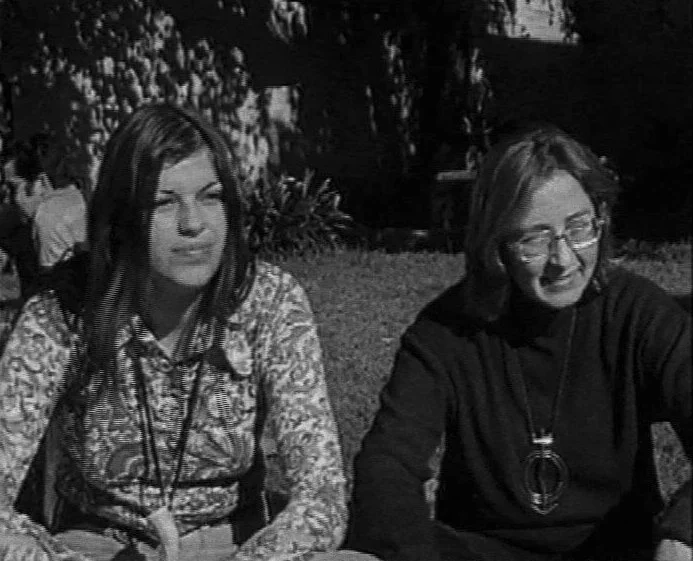
Gab and Sue at BBQ - Copy, Chequerboard, 1972 - supplied by Australian Queer Archives (AQuA)
Gay Liberation
Gay Liberation initially formed as an offshoot of CAMP INC and was particularly active on university campuses. Gay Liberation politics drew heavily from women’s liberation, especially the practice of consciousness-raising groups that encouraged introspective discussion. Gay Liberation was deeply interested in reimagining both the self and society. They fundamentally called for societal transformation and freedom from oppression for all.
They encouraged confrontation of institutions of oppression through public protests, particularly street theatre and “zaps,” short, radical bursts of action.
Mim Loftus and Pam Stein were among the more prominent lesbian members of Gay Liberation. Both wrote extensively about the place of lesbians in gay activism. They were part of a small group within Sydney Gay Liberation known as the Pissed Off Activists, who planned and performed radical protests, especially against prominent figures in the psychiatric field.
One of Gay Liberation’s biggest activist performances was 1973’s Gay Pride Week. Events were held by branches in Melbourne, Adelaide, Brisbane, and Sydney. In Sydney, police attacked a march held on the final day of the week. Footage filmed at the event by Channel Ten’s Eyewitness News shows crowds of gay men and lesbians marching, and includes an interview with Mim Loftus about the police brutality she witnessed.

Gay Pride Week march, Adelaide, 1973, from Jill Julius Matthews Collection - - supplied by Australian Queer Archives (AQuA)
Women’s Liberation
Some lesbians worked with women’s liberation groups as well as mixed gay groups, while others felt their politics aligned more closely with women’s liberation and did not participate in mixed gay organisations. A major draw for lesbians was the movement’s critique of patriarchy, demands for equality in society (especially in the workforce), and its female-led culture.
However, involvement was not without challenges. At the Sydney Women’s Commission in 1973, concerns were raised about the exclusion of lesbians from the event, and organisers and much of the audience were hostile toward lesbianism being included as a topic.
Lesbian involvement in women’s liberation shows that neither movement occurred in isolation. Ideas were shared, and organisations publicly supported external causes. Examples include:
In 1972, members of Gay Liberation and CAMP NSW marched with Women’s Liberation in Sydney’s International Women’s Day March. The march called for abortion on demand, equal pay and equal opportunity for women, free childcare centres, and a broad message of anti-sexism.
In 1973, a contingent from the CWA marched representing lesbians at the Women’s Liberation Mother’s Day March.
In 1973, members of Gay Liberation and Women’s Liberation stormed the speakers’ platform at the May Day rally to protest sexism in the labour movement, particularly the “May Queen” fundraiser. Leaflets were handed out, and the official meeting ended early, allowing members from Women’s Liberation, Gay Liberation, and Black Power groups to voice their protest. The protest succeeded in getting the May Day committee to change the fundraiser to the “Most Popular May Day Candidate.”
Also in 1973, the CWA joined the Women’s Abortion Action Campaign, supporting a range of women’s causes and joining a march on 30 June in Sydney calling for the repeal of abortion laws and free contraceptives.
Conclusion
These stories do not come close to encompassing all of the activist work lesbians undertook in the 1970s, the first decade of the gay rights movement. Lesbian involvement in gay activism was widespread beyond these actions and organisations, and continued well beyond the 1970s. Public education campaigns, marches, and TV appearances were essential to societal transformation toward acceptance of homosexuality - and lesbians played a major role in that work.
“There can be no freedom for gays in a society that enslaves others through male supremacy, racism and economic exploitation.”
Secondary Sources
de Waal, Peter and Tribunal Working Group. A Review of the 1976 Tribunal on Homosexuals and Discrimination. Balmain, 1994.Henderson, Nick. “Gay Pride Week 1973.” NFSA, 10 February 2026. https://www.nfsa.gov.au/stories/articles/gay-pride-week-1973Jennings, Rebecca. Unnamed Desires: A Sydney Lesbian History. Monash University Publishing, 2015.Jennings, Rebecca. “Sandra Willson: A Case Study in Lesbian Identities in 1950s and 1970s Australia.” History Australia 10, no. 1 (2013): 99–124.Reynolds, Robert. From Camp to Queer: Remaking the Australian Homosexual. Melbourne University Press, 2002.Ross, Liz. “We Were Catalysts for Change…” Journal of Lesbian Studies 13, no. 4 (2009): 442–460. https://doi.org/10.1080/10894160903048171Torzillo, Emma, and Heather Goodall. “Memories of Entanglement: Conflicts Around Sexuality at the Sydney Women’s Commission 1973.” Australian Feminist Studies 37, no. 111 (2022): 86–105. https://doi.org/10.1080/08164649.2022.2092836Willett, Graham. Living Out Loud: A History of Gay and Lesbian Activism in Australia. Allen & Unwin, 2000.Wills, Sue. The Politics of Sexual Liberation. PhD thesis, University of Sydney, 1981.Primary Sources
“Abortion Protest on June 30.” Tribune, 26 June 1973, p. 12.“Australia’s Biggest Women’s Demonstration.” Tribune, 14 March 1972, p. 12.“Editorial.” A.L.M. Newsletter, no. 7, August 1970, p. 1.Johnston, Craig. “May Day Massacre.” Sydney Gay Liberation Newsletter, no. 9, July 1973, pp. 2–3.Johnston, Craig. “May Day Win!” Sydney Gay Liberation Newsletter, no. 10, July 1973, p. 9.Leahy, Gillian. “Facts on May Day.” Tribune, 15 May 1973, p. 10.“Libraries.” CAMP NSW Newsletter, July 1976, p. 2.“May Day!!” Sydney Gay Liberation Newsletter, no. 8, February–May 1973, p. 3.“Mother’s Day March.” CWA Newsheet, no. 16, 16 April 1973, p. 2.“Mothers Day March.” CWA Newsheet 2, no. 1, 1 May 1973, p. 3.Munro, Neil, director. “This Just Happens to Be Part of Me.” Chequerboard (ABC TV, 1972). https://www.youtube.com/watch?v=Bp1o3DsRYpk“Public Education.” CAMP NSW Newsletter, no. 30, January 1977, p. 2.“Purpose of A.L.M. (reprinted from The Ladder).” A.L.M. Newsletter, no. 7, August 1970, p. 10.“Sydney Scene: In Out and Around the Syndrome.” CAMP INK 2, no. 6, April 1972, pp. 11–12.“What’s In It For Me?” CAMP INK 1, no. 1, November 1970, p. 2.Wills, Sue. “Intellectual Poofter Bashers.” CAMP INK 2, no. 11 (1972): 4–11.“Women’s Abortion Action Campaign.” CWA Newsheet 2, no. 1, 1 May 1973, p. 3.