
An Abridged History of Drag Kings
Welcome to the Drag King Corner - the place where we honour the legends who came before us and carved out the path we’re strutting down today. Buckle up, because we’re taking a ride through drag‑king history: the trailblazers, the rebels, the performers who bent gender long before we had the language for it.
Drag history is huge, messy, brilliant, and sometimes hidden in the shadows. So here’s the abridged version - a queer little time‑travel adventure with a feminist lens firmly in place.
Ancient beginnings: when men played women because patriarchy said so
Let’s start way back in Athens, Greece, around the 6th century BCE - widely recognised as the birthplace of Western theatre. Women weren’t allowed on stage (or even inside the theatre), so men played every role, including the female ones.
Was it “drag” in the modern sense? Not exactly. But it was one of the earliest examples of cross‑gender performance. And honestly, thank you patriarchy for birthing ancient drag entertainment.
This stayed the norm in the West until 1660, when King Charles II finally allowed women to perform onstage. Two thousand years of waiting… just to get permission from a guy in a crown. If only we’d asked him about pants too - drag kings might’ve hit the stage a lot sooner.
Across Asia: a different story
While the West kept women off the stage, parts of Asia had a more flexible relationship with gender in performance. Women played male roles in various Chinese theatre traditions, and Japan’s iconic all‑female Takarazuka Revue launched in 1914 - and is still going strong today.
Of course, colonialism reshaped many of these traditions, but the roots of gender‑play in performance run deep across the region.
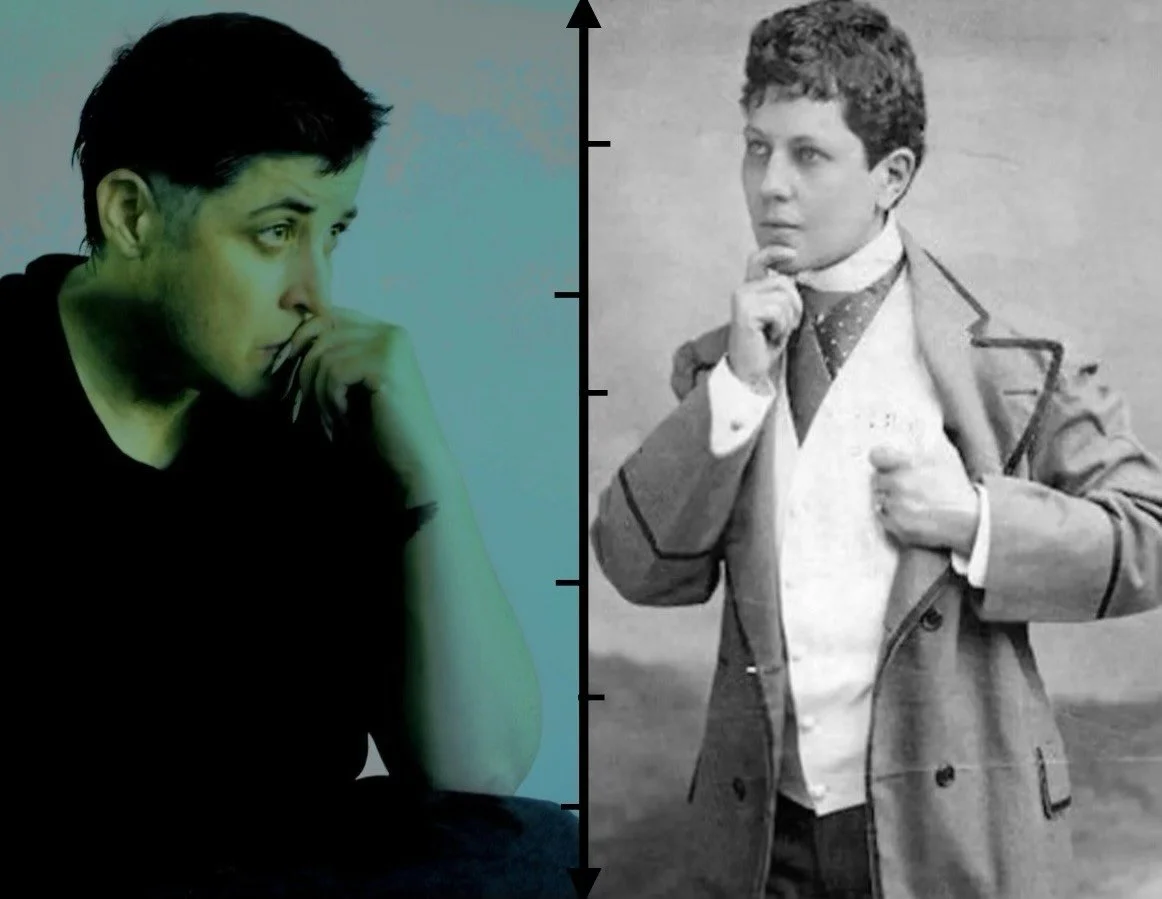
A moment in time: Drag King Dragos(L) and Ella Wesner (R) Artwork by LouNa Collective, featuring a contemporary photograph by Louise Smoothy and a historical photograph of Ella Wesner sourced from the New York Public Library Digital Collections (C.D. Fredricks & Co., c.1870).
Enter the male impersonators: the drag‑king ancestors
Fast‑forward to the late 1800s. By the 1860s and 1870s, performers like Annie Hindle and Ella Wesner were billed as male impersonators - and in the 1920's Australian born performers Nellie Small and Effie Fellows followed suit, taking to the stage.
This is where we start to see something recognisable as the early DNA of modern drag kings: women performing masculinity not just as necessity, but as art.
Stonewall and the spark that changed everything
Jump to 1969: the Stonewall uprising in New York. Stormé DeLarverie - a butch lesbian and male‑impersonator entertainer - is often cited as one of the key figures whose resistance helped ignite the night.
Stonewall rippled across the world. Drag was reclaimed, reinvented, and expanded - especially by lesbians who brought their own style, politics, and gender play into the spotlight. This is where the performers we now call modern drag kings really begin to take shape.
The 1990s: the first big drag‑king boom
The first highly visible surge of modern drag kings hit the USA in the 1990s - think Club Casanova and Mo B. Dick leading the charge. Australia followed soon after, with kings popping up in queer clubs, cabaret nights, and underground stages.
Kings rode that wave right through the 2000s and into the 2010s, even as dedicated events ebbed and flowed.
Today: post‑pandemic visibility and a new generation of kings
And now? We’re in a new era. Post‑pandemic, drag kings are everywhere - on stages, in festivals, in competitions, in digital spaces, and in communities that finally recognise the art form for the powerhouse it is.
We’re louder, prouder, and more visible than ever.
A thank‑you to our ancestors
To every non‑gender‑conforming woman and every male‑impersonator who came before us: thank you. For the fights you fought. For the stages you claimed. For the doors you kicked open so we could stand in the bright lights today.
Long live the drag king.
And if you’ve got a story about a historical Australian drag king - drop it in the comments. I want to hear it.