Extended Interview
with Tabitha Lean

We Talk About Coming Out. We Don't Talk About Coming Home from Prison.
By Tabitha Lean
The Celebrations We Know How to Hold
Queer communities have become remarkably good at celebrating beginnings. We celebrate coming out, first loves, chosen families, marriages, Pride marches, and the joy of finally being seen. We have language for these moments. We mark them with rituals, anniversaries, and photographs. They become part of our collective story about what it means to be queer. They remind us that there is life after shame, that there is community after isolation, and that there is freedom in finally being known.
Yet there is another kind of homecoming we rarely acknowledge. Every year, queer women leave prison carrying everything incarceration has taken from them and step back into communities that often have no language, no rituals, and no expectations for their return. There are no welcome‑home celebrations. No stories passed between generations about how to rebuild a life after imprisonment. There is no roadmap for finding your place again in a community that prides itself on inclusion while often struggling to embrace those whose lives have been shaped by criminalisation.
That silence matters because prison does not erase queerness. It does not suspend our identities or place our lives on pause. It simply layers another form of stigma on top of the ones many of us have already spent years learning to survive.
The Weight of a Story People Struggle to Hold
For many of us who have been criminalised, we find ourselves wondering why one part of our identity is increasingly welcomed while the other remains something people struggle to hold. Many of us know what it is like to tell someone we are queer and receive acceptance. We also know what happens when people learn that we have been imprisoned. The room changes. Conversations become more careful. Curiosity turns into caution. Suddenly we are no longer simply someone with a story. We become someone whose past must be measured, assessed, and explained.
Perhaps that is why I have always found it surprising that queer communities, of all communities, can sometimes struggle with criminalisation. We understand what it means to have our lives reduced to a single label. We understand the violence of stereotypes and the exhaustion of constantly proving that we are more than the assumptions people make about us. We know what it feels like when institutions decide who is worthy of dignity and who is not.
And yet “criminal” remains one of the last identities that many people still feel comfortable judging without question.
The Myth of Separation
There is a widespread belief that prison separates people from society, as though imprisonment somehow interrupts every other part of who we are. It is easy to imagine people in prison as existing outside ordinary life, disconnected from love, friendship, creativity, and community. That image comforts people because it creates distance. It allows us to imagine that prison contains a different kind of person.
The reality is much less convenient.
Queer women do not stop being queer when prison gates close behind them. They still fall in love. They still mourn relationships that end. They still miss their families and worry about friends on the outside. They still laugh until they cry. They write poetry, make art, share stories, dream about futures, and imagine lives beyond prison walls. They continue to negotiate gender, identity, and belonging inside institutions that are often deeply hostile to all three.
Some of the strongest expressions of care and solidarity I have ever witnessed have occurred inside prison. That may surprise people whose understanding of prison comes from television dramas or newspaper headlines. Prison is unquestionably a place of extraordinary violence. It is also a place where people survive together. Women share what little they have. They comfort one another through grief, celebrate birthdays with improvised cakes, pass books from cell to cell, protect each other during difficult times, and create moments of tenderness in environments designed to strip people of their humanity.
None of this romanticises prison. It simply acknowledges something that should be obvious: our capacity to love does not disappear because the state has decided to imprison us.
The Complications of Coming Home
Perhaps this is why returning home can be so complicated.
People often imagine release from prison as the happy ending. They picture the gates opening and freedom beginning. They rarely consider that freedom also comes with impossible questions.
When do you tell someone you have been in prison? Do you tell them on the first date? After several months? Only if they ask? Will they see you differently? Will they assume you are dangerous? Will they quietly withdraw once they know?
These questions are rarely abstract. They accompany job interviews, new friendships, community events, and intimate relationships. They sit quietly in the background of ordinary conversations. They shape decisions about disclosure in much the same way queer people have long weighed up whether it is safe to come out.
There is an important difference, however. Queer communities have spent decades building cultures that encourage people to live openly. We have challenged the idea that sexuality or gender identity should be hidden. We have created spaces where authenticity is celebrated.
We have not done the same for criminalisation.
Too often, criminalised queer people feel they must choose between honesty and belonging. They become experts at reading rooms before speaking, wondering whether this particular gathering believes in second (or third) chances or only speaks about compassion in theory. They learn which parts of themselves are welcome and which parts should remain carefully edited.
Criminalisation, Colonialism, and Queer Liberation
This is especially true for Aboriginal queer people, whose lives are shaped not only by homophobia but also by the ongoing realities of colonialism. Aboriginal people have never been mass‑represented in prisons because we are inherently more criminal than anyone else. We are mass‑represented because prisons have long functioned as one of the many institutions used to manage the harms produced by dispossession, child removal, poverty, and systemic racism. Criminalisation cannot be separated from Australia’s colonial history any more than queer liberation can be separated from struggles against policing and state violence.
These histories are deeply connected, even if we do not always speak about them together.
The Stories We Avoid
There is another uncomfortable truth that deserves attention. Queer communities often celebrate resilience, but we can also become attached to stories of redemption. We like narratives where people overcome adversity in ways that are tidy, inspirational, and reassuring. We are less comfortable with lives that remain messy - with people who continue to carry trauma, poverty, addiction, or criminal records long after they leave prison.
Yet healing has never been linear.
None of us emerge from our hardest experiences untouched. We ask queer people to bring their whole selves into community, but too often there are invisible conditions attached. Bring your whole self — unless your story makes us uncomfortable. Unless it forces us to confront prisons. Unless it complicates our understanding of justice. Unless it reminds us that exclusion still exists within spaces that speak passionately about inclusion.
“Bring your whole self - unless your story makes us uncomfortable.”
Real solidarity asks more of us than that.
It asks us to recognise that people are never reducible to the worst thing they have done, the worst thing that has happened to them, or the label that the state has attached to them. It asks us to understand that accountability and belonging are not opposites. It asks us to imagine communities capable of responding to harm without abandoning people altogether.
The Lessons We Already Know
For queer communities, this should not be unfamiliar territory. We know what it is like to build chosen families because biological families could not always hold us. We know what mutual aid looks like. We know how communities care for one another during epidemics, political attacks, and moments of profound grief. We know how to create belonging where none previously existed.
Surely those lessons do not stop at the prison gate.
Coming home from prison is not another version of coming out. The experiences are profoundly different, and it would diminish both to pretend otherwise. Yet they share one haunting question that sits at the centre of so many human lives:
Will I still belong if people know who I really am?
For too many criminalised queer women, the answer remains uncertain.
I hope that changes. Not because people leaving prison need rescuing, redeeming, or reinventing, but because they have always been part of our communities. They have always marched beside us, loved beside us, grieved beside us, and imagined freer futures beside us. Prison may have interrupted their lives, but it did not erase their humanity or their place among us.
“Prison may interrupt a life, but it does not erase a person.”
If queer liberation means anything, surely it means refusing to let the state decide who belongs. It means recognising that our communities are strongest not when they are made up of perfect people with uncomplicated histories, but when they make room for the full complexity of human lives.
Perhaps that is the homecoming we still need to learn how to celebrate.
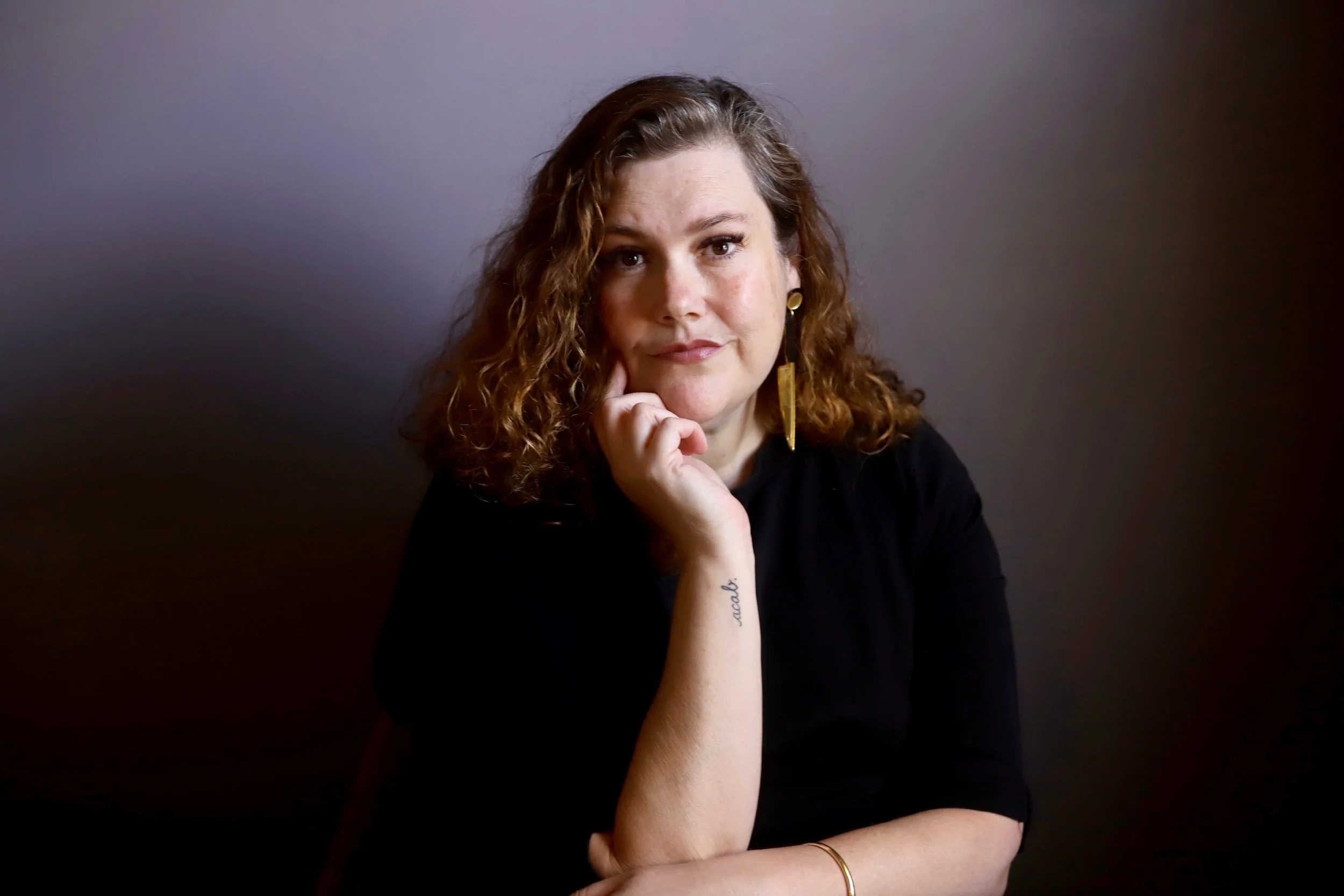
Tabitha Lean is a criminalised, MAD survivor and resister. She is a poet, artist, storyteller, disruptor, and troublemaker. Her work emerges from lived experience and is grounded in collective care, creative resistance, and the refusal of carceral and psychiatric control. She lives and creates at the margins - with love.
Listen Up
Prefer to listen to the Podcast? Listen to the LOTL Lounge