Butch and femme lesbians are a fixture of modern lesbian culture. Lesbians expressing their masculinity and femininity through dress and behaviour have existed throughout history; for example, the main character of Radclyffe Hall’s The Well of Loneliness, or historical figures like Anne Lister. The modern labels of butch and femme and their associated images specifically developed in post-war lesbian bar scenes, often associated first with New York City in the 1950s and 1960s.
Butch and femme labels are tied to image and behaviour. Typically, a butch lesbian dressed in a masculine style, and a femme was a lesbian who dressed in a feminine style. Their behaviours in relationships were also related to these identities, with the common understanding of a butch/femme relationship dynamic being one where the butch played a more dominant role sexually and domestically, and the femme played a more submissive one. These identities flagged people’s desires and formed a recognisable image of lesbian identity. This article offers a brief look at the history of these identities in Australia, from the 1960s to the 2000s.
The 1960s
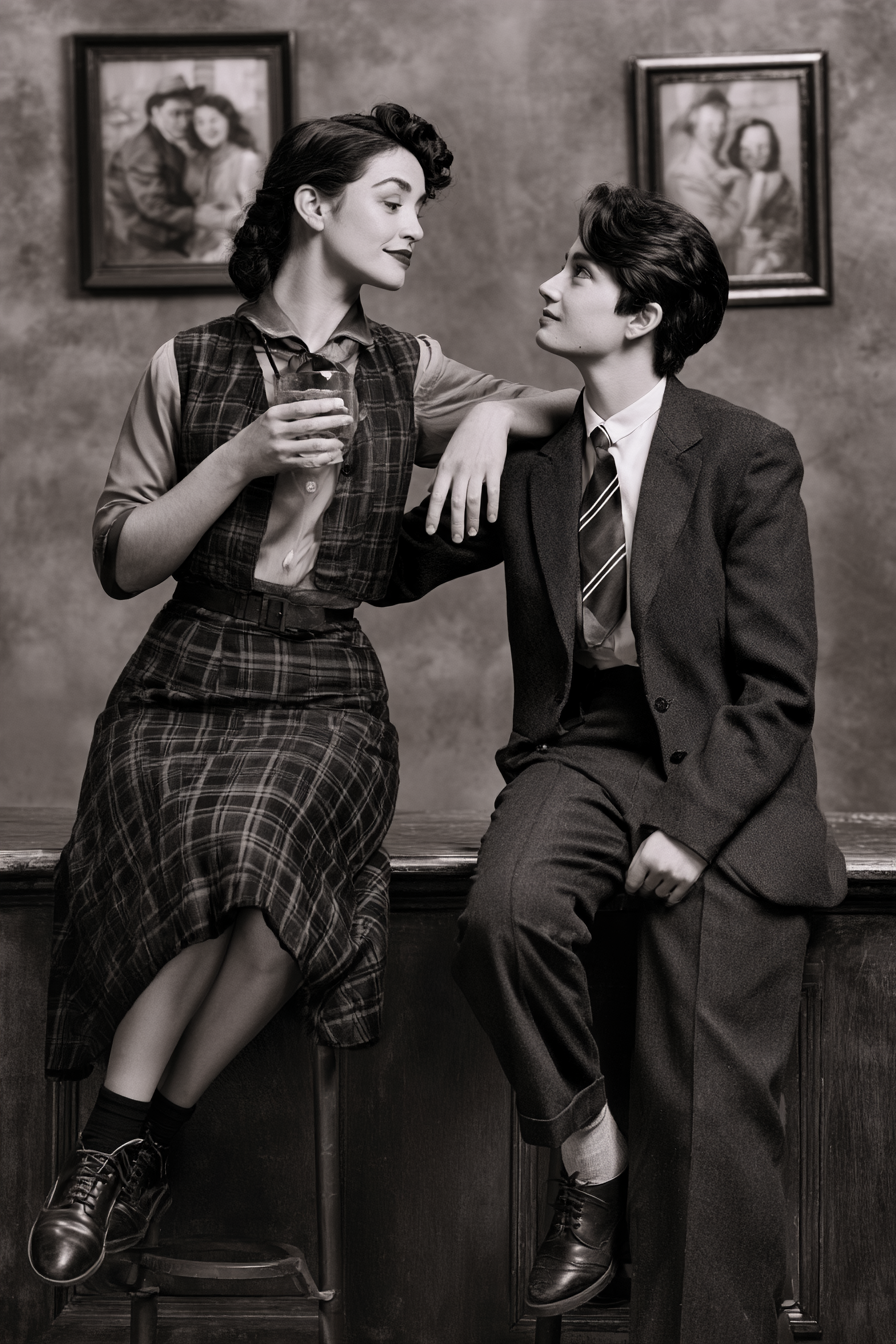
In Australia, the camp scene entered the public in the 1960s with the first camp bars opening. Some of these bars catered specifically to lesbians, and it was in these spaces that lesbian identities and culture developed. Butch and femme couples were a fixture in these bars, as they were the safest place available to express a lesbian identity. The culture in bars would vary; in some, butch and femme couples would be dancing together and mixing, in others butches would all congregate together, and femmes would also separate into another group. It was frowned upon for butches to get together, or for femmes to. They could socialise in groups, but a relationship had to be between a butch and a femme.
The fashion expectation in these spaces was to be sharply dressed, with many butches wearing a three-piece suit. Hair and grooming standards also followed, with butches wearing their hair short and femmes wearing theirs long. When being introduced to the scene by other lesbians, it wasn't uncommon to be taken to buy a new outfit from menswear sections and have a new haircut done to help embrace a butch identity, or to be encouraged to continue wearing dresses and take on the label of femme. Police persecution against lesbians included clauses which could be used to target butch lesbians specifically, with some jurisdictions having anti cross-dressing rules requiring three items of “women’s” clothing to be worn.
Many anecdotes from women going out for a night on the town recalled dancing with a sharp young man in a bar and being pleasantly surprised to discover the young man was actually another woman. For example, Colette Parr in Out and About: Sydney’s Lesbian Social Scene 1960s-1980s recalled: “He turned out to be a woman in full drag, so this was terribly exciting for me. She looked like a boy, but she was a girl. This was exactly what I was looking for.”
She looked like a boy, but she was a girl.
This was exactly what I was looking for.
The 1970s and 1980s
The 1970s in Australia saw the entry of lesbians into the public and into political activism. This came amongst a wave of rising feminist and gay politics, all with an emphasis on bringing personal problems to the public and campaigning for rights based on the collective problems experienced by marginalised communities. The presence of feminist politics in gay spaces and conversely the presence of lesbians in feminist spaces provided a vast platform through which debates around identity were performed.
Butch lesbians, especially, by their nature as lesbians who visibly diverged a considerable amount from the traditional image of how a woman should express herself, became the stereotypical image of the lesbian, and thanks to that visibility, were the targets of lesbian feminists seeking to create a new image of a lesbian. Debates raged over the ethics of butch/femme dynamics. Many lesbians in gay and feminist political spaces debated whether these dynamics were a mirror of heterosexual gender roles which reinforced power dynamics that oppressed women in the home, or if they were a parody of those same roles, or an entirely separate innately lesbian expression of masculinity and femininity in a relationship. Liz Ross, in 1982, pondered how to grapple with the concept of butch/femme identities having been a progressive act of lesbian visibility in the past, but then, at her current time, being an oppressive dynamic. “How do we come to terms with our own conditioning or break away from that conditioning without denying our herstory?”
It is important to note that within lesbian culture, identity was connected to class, as butch identity especially grew out of working-class culture, and some butch lesbians saw class differences preventing them from being able to contribute to political discourse. Many lesbian feminists were middle-class and student activists, whose economic and social backgrounds differed greatly from the largely working-class demographics of butch lesbians in the bar scene. Stevie, a LOTL contributor, recalled that, in her experience in the 1970s, “there were three types of lesbians: politically correct types who you would rarely see in a bar; gutter dykes, i.e. butch and femme; and us, somewhere between the two.” Similar tensions existed between political and “apolitical” gay men who frequented the bars, but the combination of gay and feminist influences on lesbian politics encouraged a much stronger discourse.
The dress styles of lesbian feminists also drew on ideas of disavowing traditional expressions of femininity, with many choosing to wear a “uniform” of slogan t-shirts and jeans. This style of dress, like that of butches and femmes, also performed masculinity and femininity in specific ways to create an image of a lesbian that challenged traditional expectations of dress and behaviour for women. This created a stereotypical image of the androgynous dyke, somewhat overtaking the image of the butch lesbian as the main idea society had of a lesbian. While tensions existed between butch/femme and feminist lesbians, many of them still existed in the same spaces and socialised together, because the bars were one of the only spaces that lesbians could socialise in, regardless of their differences. Bar lesbians were also not entirely apolitical; both overseas and in Australia, the rise of protest marches and parades saw activists and those from the bar scenes coming together in the gay movement. The call from Sydney’s first Mardi Gras of “Out of the Bars and onto the Streets” showed this collaboration between two spheres which did not always agree, but were not as completely opposed to each other as first impressions would suggest.
The 1990s and 2000s
Entering the 1990s and 2000s, the identities of butch and femme started to become reclaimed. The rise of lesbian media like Lesbians on the Loose provided a new platform for lesbian identity to be expressed and shared. LOTL featured several articles including features on butch and femme weddings, and how those dynamics could be expressed in a world where lesbian identity was visible in the mainstream world and wasn’t confined to the privacy of the bars. Some commentators retained beliefs of butch/femme identities as being a mirror of a heterosexual dynamic, like Beth Gilligan’s 1994 LOTL piece The Era of Our Ways: 1960s butch and femme, where she argued that “perhaps the establishment of butch and femme roles unconsciously provided a sense of legitimacy in a society where they perceived themselves to be at odds with convention.”
At the same time, however, there was a rising question of what these labels meant in a modern world where lesbians were visible and gendered fashions and behaviours as a whole for all women became more fluid. Lesbian scholar Lillian Faderman noted that fashions for butches and femmes became more varied again, “femmes have felt much freer to wear dresses and even extreme feminine garb than they would have in the radical 1970s. It represents play and style, as does the extreme masculine garb that some latter-day butches wear.”
There was a rising emphasis on self-expression and each person’s connection to labels. Sexual dynamics were becoming less rigid, with butch/butch and femme/femme relationships becoming less taboo, sexual behaviours like butches being dominant and femmes being submissive also became more fluid and varied depending on the individual. Individual connections to the labels of butch and femme were encouraged, rather than attachment to strict definitions of dress and behaviour. According to Stevie, “I think it’s more a matter of dykes behaving the way that feels right and then looking for a label for it… For me the whole debate comes down to each individual’s choice and right to name themselves. I think butch (or femme), therefore I am… The bottom line for me is that every woman has the right to name herself and to expect other women to respect that choice.”
For Merrilee Moss in Lesbiana, “It’s no wonder we’re desperate to embrace queer theory, to become more fluid and jump onto that great continuum of shifting desires. I mean, identities can help to define us, but who wants to become stuck? And, of course, identities can be used to oppress us… When it comes down to it, I guess it’s about gender, your perceptions and how comfortable you feel.”
For Lori Hartman in Quirk, “I think you get to create your own identity. Have fun with it!”
[1] Eleanor Medhurst, Unsuitable: A History of Lesbian Fashion, (London: Hurst & Co., 2024), pg. 101.[1] Rebecca Jennings and Sandra Mackay, Out and About: Sydney’s Lesbian Social Scene 1960s-1980s, (Sydney: Pride History Group, 2009), pg. 12.[1] Jennings and Mackay, Out and About, pg. 12.[1] Jennings and Mackay, Out and About, pg. 13.[1] Colette Parr, cited in Jennings and Mackay, Out and About, pg. 14.[1] Caroline Ainsley and Madeline Paterson, “Lesbian Charm and Sex-Appeal,” CAMP Ink 2, no. 12 (1972): 14; Willem Tetro, “Oppressed or Oppressor?,” CAMP Ink 4, nos. 3–4 (1975): 14; Susan Williamson, “Living Without Men,” CAMP Ink 2, no. 7 (1972): 10; Angelo Rossas, “Nuclear Destruction,” CAMP Ink 4, nos. 3–4 (1975): 13.[1] Liz Ross, “Butch and Fem: Roles in Lesbian Relationships,” Gay Community News 4 no 1, (February 1982), pg. 26.[1] Emma Torzillo and Heather Goodall. “Memories of Entanglement: Conflicts Around Sexuality at the Sydney Women’s Commission 1973,” Australian Feminist Studies 37, No 11 (2022), pg. 97.[1] Stevie, “Butch & Femme: A Dying Breed?” Lesbians on the Loose 3, no 5, (May 1992), pg. 14.[1] Jennings and Mackay, Out and About, pg. 30., see also Chapter 16 “Uniforms of the Second Wave: Lesbian Feminist Dress Codes” and Chapter 17 “T-Shirts: The Billboards of the Body,” in Medhurst, Unsuitable, pg. 175-196.[1] Jennings and Mackay, Out and About, pg. 31-32.[1] Joan Nestle, “Butch/Fem in the ‘50s”, Gay Community News 4, no 7. (Sep 1982), pg. 30.[1] Emma & Jas: Butch Femme Wedding,” Lesbians on the Loose 20, no 1, (Jan 2009), pg. 40.[1] Beth Gilligan, “The Era of Our Ways: 1960s Butch and Femme”, Lesbians on the Loose 4, no 10, (Oct 1994), pg. 20.[1] Lillian Faderman, “The Return of Butch and Femme: A Phenomenon of Lesbian Sexuality of the 1980s and 1990s,” Journal of the History of Sexuality 2, no 4, (Apr 1992), pg. 592.[1] Stevie, “Butch & Femme: A Dying Breed?” Lesbians on the Loose 3, no 5, (May 1992), pg. 15.[1] Merrilee Moss, “Femme Rising,” Lesbiana no 76, (Feb 1999), pg. 4.[1] Lori Hartman, “Butch: An Evolving Identity.” Quirk no 11, (Apr 1999), pg. 33.Sources Sources:Ainsley, Caroline, and Madeline Paterson. “Lesbian Charm and Sex-Appeal.” CAMP Ink 2, no. 12 (1972): 14.Emma & Jas: Butch Femme Wedding,” Lesbians on the Loose 20, no 1. (Jan 2009): 40.Faderman, Lillian. “The Return of Butch and Femme: A Phenomenon of Lesbian Sexuality of the 1980s and 1990s,” Journal of the History of Sexuality 2, no 4. (Apr 1992): 578-596.Gilligan, Beth. “The Era of Our Ways: 1960s Butch and Femme”, Lesbians on the Loose 4, no 10. (Oct 1994): 20-21.Hartman, Lori. “Butch: An Evolving Identity.” Quirk no 11. (Apr 1999): 32-33.Jennings, Rebecca, and Sandra Mackay. Out and About: Sydney’s Lesbian Social Scene 1960s-1980s. Sydney: Pride History Group, 2009.Medhurst, Eleanor. Unsuitable: A History of Lesbian Fashion. London: Hurst & Co., 2024.Moss, Merrilee. “Femme Rising,” Lesbiana no 76. (Feb 1999): 4-5.Nestle, Joan. “Butch/Fem in the ‘50s.” Gay Community News 4, no 7. (Sep 1982): 29-31.Ross, Liz. “Butch and Fem: Roles in Lesbian Relationships.” Gay Community News 4 no. 1, (February 1982): 26-27, 31.Rossas, Angelo. “Nuclear Destruction.” CAMP Ink 4, nos. 3–4 (1975): 12–13.Stevie, “Butch & Femme: A Dying Breed?” Lesbians on the Loose 3, no 5. (May 1992): 14-15.Tetro, Willem. “Oppressed or Oppressor?” CAMP Ink 4, nos. 3–4 (1975): 14.Torzillo, Emma, and Heather Goodall. “Memories of Entanglement: Conflicts Around Sexuality at the Sydney Women’s Commission 1973.” Australian Feminist Studies 37, no. 111 (2022): 86–105.Williamson, Susan. “Living Without Men.” CAMP Ink 2, no. 7 (1972): 10–11.